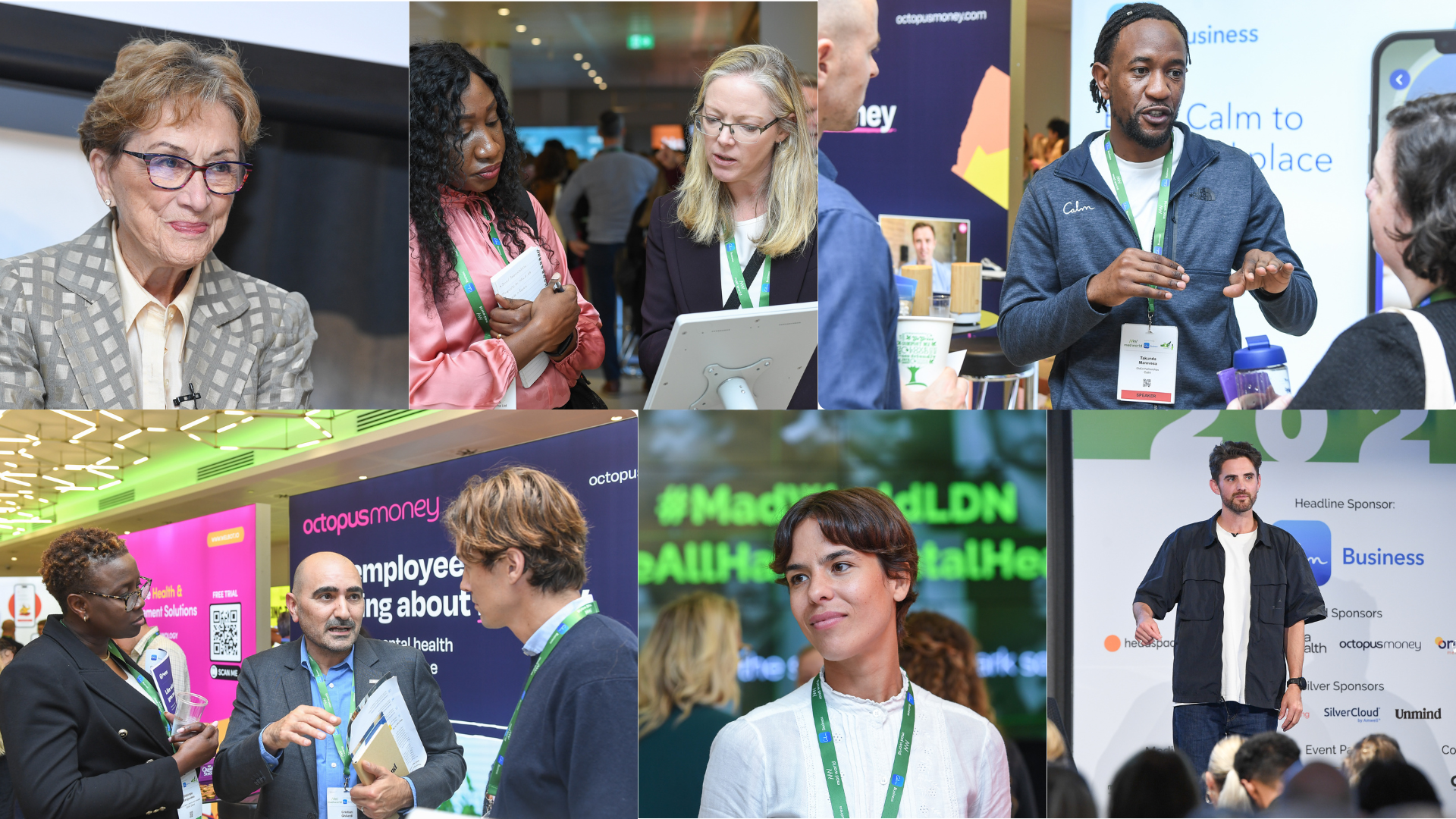





2025 Speakers
Dame Carol Black GBE
Dr Monika Misra
Marc Molloy
Paula Stannett
Dr Richard Peters
Dr Shriti Pattani OBE
Tom Kegode
Chloe Muir
Charles Alberts
Gethin Nadin
Dr Lia Ali
Arti Kashyap-Aynsley
The 8th Annual MAD World Summit
Rethinking work, reimagining engagement, reinforcing health & wellbeing
Since launching in 2018, the MAD World Summit has been at the forefront of redefining employee health and wellbeing. In 2025, we’re going even further. This year, MAD World brings together four powerful tracks in one transformative day — built to break silos, spark cross-functional collaboration, and align workplace culture, employee health and wellbeing with business strategy.
As organisations adapt to ongoing change — from economic pressure to shifting employee expectations — the focus is no longer just on why health and wellbeing matters, but on how to make it work as a strategic lever for engagement, growth and performance. Senior leaders across functions are now asking:
- How do we move from fragmented efforts to integrated strategy?
- How do we focus on delivering measurable outcomes and ROI?
- How do we design work to support people — and enable performance?
“From strategic insights to practical takeaways, sessions are carefully curated to help you navigate uncertainty in an increasingly volatile world, support your people more effectively, and unlock their full potential—now and into the future”.
Claire Farrow, Global Head of Content, Make A Difference
Topics we’ll be addressing include:
- Debate: Employee health and wellbeing – strategic imperative, moral mandate or both?
- Keeping Britain working: The employer’s role in shaping a resilient economy through prevention, retention, early intervention and rapid rehabilitation
- Power in Alignment: How CHROs, CFOs and CIOs are collaborating to make health and wellbeing a business driver
- Leading through change: Supporting employees’ health and wellbeing through uncertain times
- Future-proofing health benefits: Focusing on prevention to manage rising costs without compromising care
- Navigating AI Disruption: Protecting employee health and culture in a tech-driven future
- Emerging health risks and how employers can prepare to maintain business resilience
- EAPs in a VUCA world – are they fit for purpose?
- Unpacking Psychosocial Risk: What’s driving it – and what employers must change
- DE&I in the new world order: Building workplaces that support everyone’s health and potential
- Future-proofing talent: Integrating health, wellbeing and skills development in a multi-generational workforce
- From Insight to Action: How the legal sector can lead with a data-driven approach to supporting mental health, wellbeing and culture
- Miscarriage to menopause: are workplaces failing women?
- The strategic advantage of a financially fit workforce
And more.
The MAD World Summit will bring together senior decision-makers from HR, Finance, Benefits, DE&I, Health & Safety, L&D, Culture, Occupational Health, and Communications — all committed to integrating health and wellbeing into the core of how business gets done.
Wherever you are on your journey, join us for the UK’s leading B2B event for workplace culture, health and wellbeing. You’ll leave with the tools, connections and confidence to make wellbeing strategy a business advantage — not just a business case.

We'll Be Sharing
Latest Make A Difference News

Our Movers and Shakers articles highlight who’s moving up, out or across in the rapidly evolving world of workplace culture, employee health and wellbeing. Here’s a selection of just a few of the many “movers and shakers” that grabbed my attention in November 2025.
Kirstin Furber
First up is the fabulous Kirstin Furber. After five years as People Director at Channel 4, Kirstin has taken up the post of People Director, Manchester United. Writing about her move on LinkedIn Kirstin said: “I’m excited to join Manchester United and help build a culture where people can thrive and make a real impact on and off the pitch”.
Kirstin brings with her a font of knowledge and experience gained both at Channel 4 and across a host of employers in the creative industries, including Kantar, BBC Worldwide, 20th Century Fox and Discovery Networks Europe. She’s also Non Executive Director of British Wheelchair Basketball.
Kirstin is also fascinated by The Sunday Night Blues. Why do people feel down over the thought of going back to work on a Monday? And, importantly, what can leaders and managers do about it? She’s led research into this, examining the causes and solutions that help to improve Mondays and banish the ‘Sunday Scaries’.
You can find out more here and also in this profile interview in which Kirstin shares how her own experiences have deepened her understanding of those that are struggling both with their physical and mental health.
Anne-Marie Lister
Next is Anne-Marie Lister who, in November this year, took up the post of Chief Operations and People Officer with property finance and online savings account provider GB Bank. Prior to this, Anne-Marie was Chief People Officer with Atom Bank where she was an advocate for, and successfully led the implementation of the four-day week.
You can find out more about how Anne-Marie approached this in this article where she explains that “You can’t be innovative without being brave” and in this webinar, where Anne-Marie spoke about how the four-day week can fit into a wider workplace health and wellbeing strategy.
Denis Ogbe
It was also great to see that Denis Ogbe, formerly Global Wellbeing Specialist with Brown-Foreman, has moved to Yum! Brands as their Associate Manager, Global Benefits.
On LinkedIn Denis wrote: “This new chapter means so much to me, a reminder that faith, perseverance, and community can truly open doors. I’m deeply thankful for the mentors, colleagues, mentees, and friends who have supported, challenged, and believed in me along the way. Your encouragement has made all the difference. I’m ready to learn, contribute, and grow with this incredible organization and team, and I can’t wait to see what’s ahead! Here’s to new beginnings, meaningful work, and growth that comes from never giving up”.
Well said Denis!
Naomi Cosgrove
Next up is Naomi Cosgrove who has been promoted to Senior HR Programme Manager, Wellbeing, Inclusion and Benefits at IRIS Software Group. That’s quite a job title and is perhaps and indication that health and wellbeing are becoming woven into the fabric of life at IRIS Software Group.
Writing on LinkedIn Naomi said: “Thanks to all my wonderful colleagues who genuinely help me grow and learn and have supported and championed me on my journey at IRIS!”
You can find out more about the great work that Naomi and her colleagues at IRIS have been doing in this feature that shines a spotlight on the innovative approach taken to support older workers as an essential part of the multigenerational workforce.
Karen Smith
Another Mover & Shaker in workplace culture, employee health and wellbeing that caught my eye is Karen Smith who wrote on LinkedIn: “I’m delighted to share that I’ve have been promoted to Organisational Wellbeing Lead at BDO from 1 November. I am looking forward to working with colleagues on future plans for wellbeing at BDO”.
We’re looking forward to hearing more about this too Karen.
Karen is a member of our Make A Difference Leaders’ Club. You can find out more about this and apply to join here.
Sarah Restall
Last but certainly not least is the inimitable Sarah Restall – one of the most authentic and respected voices in workplace culture and employee health & wellbeing. After honing her skills at Mind (working with Time to Change) and across a host of leading-edge organisations – most recently as Head of Strategy and Success at Smart About Health – it’s great to see Sarah now stepping out on her own as a culture and wellbeing strategic consultant.
Her new venture, Hello All Consulting, will help organisations build the business case for wellbeing investment; run culture audits and gap analyses to pinpoint what to improve (and how); shape narratives that secure genuine leadership buy-in; design 1–3 year culture and wellbeing strategies that work in real life; and provide project-based advisory support when you need that external perspective.
We wish you every success in your new venture, Sarah – you’re sure to smash it!
You can read more about Sarah’s perspective in the many articles that she has contributed to on www.makeadifference.media. Including this one on next level ERGs and Champions networks and this one where she shared her predictions of priorities for 2025.

Movers & shakers in workplace culture, employee health and wellbeing
At the final Make A Difference Leaders’ Lunch of 2025 – sponsored by Personify Health and hosted by Ipsos Karian & Box – senior leaders in HR, occupational health, wellbeing, DEI, health and safety, employee benefits, and organisational culture came together to take stock of a turbulent year – described more than once as “funky… and not in a good way” – and to consider what employers must prioritise in 2026.
Against a backdrop of tight budgets, organisational restructures, workforce anxiety, rising sickness absence, and geopolitical uncertainty, participants were candid: wellbeing is at a crossroads. Yet the session also revealed deep pockets of innovation, resilience and progress, especially where organisations have stayed data-led, invested in leadership capability, built psychologically safe cultures and collaborated across functions.
The newly published Keep Britain Working review added crucial context. Leaders debated the practicalities of becoming a Vanguard organisation, the role of the proposed national Health & Work Intelligence Unit, and how to translate the review’s ambitions into real progress on the ground.
Wellbeing is at a crossroads
Across the panel contributions and roundtable discussions, four themes emerged clearly:
| 1. Leadership capability will make or break progress in 2026 | Visible, human and accountable leadership – not standalone wellbeing initiatives – is now seen as the defining factor of organisational health. |
| 2. Data maturity is no longer optional | The shift from “initiatives” to measurable, evidence-based people strategy is accelerating fast. |
| 3. A reset in language and framing is needed | Many argued that the word “wellbeing” has become too diffuse or trivialised; 2026 may require a rebrand focused on “people risk”, “enhancing people capital” or “health engagement”. |
| 4. Cultural nuance and system design matter more than ever | Employers must better tailor approaches by generation, job type, geography, working conditions and identity – a cross-cutting theme echoed repeatedly. |
Despite a tough year, optimism surfaced: organisations with strong leadership support, clear data and collaborative cross-functional working continued to make meaningful strides in 2025. The insights below capture the essence of the collective intelligence shared.
Setting the context: Dame Carol Black GBE

Pioneer and foremost expert of employee health and wellbeing Dame Carol Black GBE opened the session by inviting attendees to reflect on three questions:
- What has gone well, and what has been challenging in 2025?
- What do you most want to achieve in 2026 that will genuinely move the dial?
- How should employers respond to the Keep Britain Working review?
She emphasised the review’s call for better data to show employers what does and doesn’t work, the establishment of Vanguard employers – a group of 60 early adopters, including British Airways, Google, Sainsbury’s, Holland & Barrett, Mayoral Combined Authorities and SMEs – who will develop and refine workplace health approaches over the next three years to build a stronger evidence base, and the proposal to create a new Health & Work Intelligence Unit.
Before opening to the attendees for their thoughts, a panel of experts shared their perspectives.
A divided year: “Funky… but hopefully pivotal”

Jill King, SVP International, Personify Health
Jill offered one of the most provocative thoughts of the day: “I think the wellbeing industry needs a rebrand.”
She argued that 2025 exposed a widening gap between organisations undertaking sophisticated, data-led work and those who, under pressure, defaulted to low-impact “tick-box” activities that fail to influence outcomes or secure sustained investment.
Jill suggested a future framing around reducing people risk and improving health engagement. This better reflects the strategic importance of the work and resonates with executive decision-makers.
Collaboration as the catalyst

Dr Clare Fernandes, Medical Director EMEA, Haleon
Despite the pressures of 2025, Clare highlighted genuine progress through:
- Deeper cross-border collaboration
- National input into the Keep Britain Working review
- International work with the World Health Organisation and the International Labour Organisation
- Stronger integration of employee benefits data into health strategy
She argued that effective collaboration – internally and externally – is the accelerator employers need in 2026, especially when resources are tight:
“Collaboration is what enables us to thrive together and gain leadership buy-in.”
Dr Clare Fernades
A shift toward human-centred leadership

Katherine Billingham-Mohamed, Leadership & Engagement Director, Ipsos
Katherine framed employee wellbeing as an outcome of strong culture and leadership.
She has seen encouraging progress in organisations moving from surface-level wellbeing activities to deeper, structural drivers: looking at things like job design, workload, organisational design and personalised support for different demographics (particularly menopause, trans inclusion and neurodiversity) and essentially course leadership capability.
She also flagged an emerging challenge for 2026: the need to support employees – and leaders – through AI adoption, which she framed as “a culture, mindset and skillset change, not just a tech change.”
Voices from the room: reality check and green shoots
The open discussion that followed revealed the breadth of experiences across sectors. Several themes stood out:
1. Funding cuts and “panic decisions” are hitting hard
Many shared stark examples:
- Wellbeing and DEI budgets frozen or reduced
- Consideration of removing cancer cover to reduce PMI costs
- Leaders questioning whether employees on long-term sick were “really sick”
“In a nutshell, people seem to have forgotten the humanity.”
2. Yet many organisations are delivering exceptional progress
There were also standout success stories:
- TfL’s new wellbeing plan and exemplary health-data insights from its health-check kiosks, which are helping to secure senior leadership buy-in
- Engagement in wellbeing at KP Snacks has never been higher and this is reflected in year-on-year reductions in wellbeing age, as well as a reduction in short-term absence
- Manufacturing company Abraham Moon & Sons’ knowledge-transfer partnership with Leeds Beckett University which digitises standard operating procedure training to enable squeezed middle managers to support team members in other areas such as wellbeing
- Fast-maturing cross-regional health strategies in multinational organisations
“Absence is always a reflection of culture.”
3. The profession is wrestling with its identity
Across participants, a consistent sentiment emerged: The word “wellbeing” isn’t working.
Some argued it is too broad and easily misinterpreted, is associated with low-value activities, fails to compel the C-suite, and does not reflect the complexity of the work.
Yet others cautioned against abandoning it entirely, emphasising the need for education, shared language, and strategic reframing, not wholesale replacement.
The Keep Britain Working Review: promise and practicalities
The publication of the Keep Britain Working review formed a critical backdrop. While many welcomed the Review’s national recognition of employer responsibility – alongside employee and government responsibility – several concerns emerged. These included the pace and clarity of implementation, the risk of policy disruption, the challenge of applying large-organisation models to SMEs, and the limitations of using sickness absence as a measure of success.
Inside the Vanguards: early thoughts
Representatives from Transport for London, PwC and Haleon – all Vanguards – shared early thoughts around:
• Understanding what data will need to be collected to support benchmarking for instance:
- Across disability, long-term sickness, return-to-work rates
- Reasonable adjustments and job design
• Clarity on “what good looks like” is urgently needed
A shared framework will help create a consistent standard for practice.
• Connection and early intervention are key to supporting people back to work
Organisations can find it hard through data and communication to manage long-term sick employees. It can be hard to ensure the employee while off sick maintains connection with the organisation; employers want guidance on the right boundaries and expectations.
Roundtable insights: eight priorities for 2026
Roundtable discussions brought rich insight into what leaders believe must take centre stage next year.
1. Leadership capability & human skills
This was the strongest recurring theme across all tables.
Priorities included:
- Human-centred leadership development
- Teaching leaders how their own psychology affects performance
- Coaching leaders on their personal wellbeing
- Reducing over-reliance on line managers by improving system design
“You can’t embed health and wellbeing without leadership accountability”
2. Data Maturity & Evidence-Based Strategy
Key elements identified:
- Strengthening capacity for data analysis
- Linking wellbeing metrics with performance and productivity
- Understanding “unknown costs” such as legal risk, presenteeism and turnover
- Better integration of qualitative listening with quantitative dashboards
3. Personalisation and Generational Nuance
Leaders highlighted:
- Tailoring approaches for the “Covid generation”
- Expanding focus on male health, fertility, menopause and neurodiversity
- Designing multi-generational support for five generations in one workforce
- Cultural nuance across global markets
4. Reframing Workload, Job Design & Organisational Structure
Recurring issues included:
- Overwhelm
- Distraction and constant task switching
- Lack of clarity around priorities
- Outdated structures that push people into management roles they do not want
Participants highlighted progressive models separating career progression from managerial responsibility – an approach gaining momentum.

5. Embedding Inclusion & Removing Systemic Barriers
Themes included:
- Embedding reasonable adjustments
- Strengthening inclusive cultures, not just inclusive policies
- Supporting the wellbeing of content creators, customers and contributors
- Using inclusion passports and reflective practice
6. AI Readiness: A Culture, Capability & Wellbeing Issue
AI came up in every roundtable.
Key points:
- Supporting leaders and employees through AI-related change
- Using AI tools for health and wellbeing engagement where appropriate
- Addressing anxiety, skills gaps and job redesign
- Leveraging AI literacy as a hook for wider engagement
7. Smarter Use of Existing Benefits & Programmes
Tables emphasised:
- Maximising utilisation of existing employee benefits
- Improving communication and education
- Reducing waste by aligning benefits with actual needs
- Moving from “push” communications to “pull” engagement
8. A Holistic, Preventative Approach
One table introduced the concept of: “The 360° human footprint of work.”
This included:
- The need to revisit basics such as sleep and nutrition
- Consideration of community impact
- Early intervention in behaviour and culture
- Alternative dispute resolution
Conclusion: A Year of Hard Truths – and a Turning Point
If 2025 exposed the fragility of wellbeing across UK workplaces, the Leaders’ Lunch showed something more important: a determination to rebuild with more rigour, more evidence, more realism and more humanity.
Across the room there was a clear sense that 2026 must be the year employers:
- Get serious about leadership capability
- Invest in data maturity and measurement
- Reframe wellbeing in strategic, commercial terms
- Design work sustainably for every generation
- Prepare people for AI-driven change
- Collaborate internally and externally
- Focus on prevention as well as intervention and rapid rehabilitation
- Personalise health and wellbeing to support inclusion and engagement
- Maximise existing resources with an agile offering that withstands organisational change
Perhaps most importantly, the discussions revealed a shared belief that employee health and sustainable performance are inseparable, and that to have real impact, wellbeing – whatever we call it next – must be woven into organisational culture, leadership and strategy.
The Make A Difference Leaders’ Club will continue to foster the collaboration that enables employers to enter 2026 with clarity, courage, and renewed commitment to meaningful change.
A message from the Make A Difference Leaders’ Club sponsor:

As we reflect on 2025 and look toward 2026, organisations need clarity – not assumptions – to make meaningful progress with the health and performance of both their people and their organisation. The Personify Health Maturity Assessment provides a clear, evidence-based picture of where you as an organisation stand today, highlighting strengths, gaps and the most impactful priorities for the year ahead.
It transforms your wellbeing strategy from ‘good intentions’ into a focused, action orientated roadmap. By knowing exactly where you are, you can move forward with confidence, purpose and measurable impact.
And the best bit? It’s completely free of charge! Please make the most of this fantastic opportunity and complete the Maturity Assessment today.
You can find out more about the Make A Difference Leaders’ Club and apply to join here.
You might also like:

Make a Difference Leaders’ Lunch report: reflecting on 2025 and setting priorities for 2026
The rules of the employee engagement game have changed.
It used to be enough to ask a couple of questions about how employees were feeling about their wellbeing in an annual, or twice yearly, survey and that was enough to assess ‘engagement’.
But those days are over. With hybrid working, geopolitical uncertainty, increasing desire for purpose and a host of other factors, employee expectations have shifted.
To talk us through tackling this change on the podcast this week, is Euromonitor’s Global Director: Culture, Engagement and Inclusion, Adeife Onwuzulike, who is currently grappling with exactly this challenge.
She covers a huge variety of topics with practical and strategic advice such as: the importance of co-design and collaboration; the multigenerational workforce; measurement; intersectionality and much more.
One thing she makes crystal clear is that engagement today is all about two-way participation and employees want to be talked ‘with’ and not ‘to’.
To give you a flavour, at one point she says:
“ Everything that we are all trying to do now is build trust across the different ecosystems within our business. And trust is fuelled by participation. Trust is fuelled by a sense of good wellbeing. Trust is filled by the feeling of growth. When you start to look at it for that lens, you can’t help but think about how it’s a co-design approach as opposed to a top down.”
How to keep employees working (and engaged)
She also echoes one of the key themes that Sir Charlie Mayfield identifies in the Keep Britain Working review:
“One of the things we don’t really talk about, but we should, is this undertone of fear. There’s a lot of fear that’s driving sentiment.”
A self-confessed lover of honest conversations, she doesn’t shy away from inconvenient truths in this one, such as how business – regardless of pressure and time constraints – must find time to prioritise building relationships; the bedrock of trust and psychological safety.
As for professionals in the Workplace Culture and Employee Health and Wellbeing space? They need to have more grace, and patience, because cultural transformation takes time.
She explains how she is addressing these many challenges at Euromonitor and she even sings at the end, so stay tuned for that, and, of course, the alien question….
Listen on Spotify, Apple or wherever you get your podcasts. And why not share it with a colleague, or c-suite member, who would benefit from hearing the conversation?
Time line of conversation:
00:00 Introduction to the Leaders Podcast
00:35 This Week’s Challenge: Employee Engagement
01:44 Guest Introduction: Aade Zalucki
02:34 Designing a New Employee Experience Survey
03:51 Measuring Employee Experience
08:35 The Importance of Wellbeing and DEI
11:52 Building Trust and Collaboration
13:45 Generational Differences in the Workplace
18:48 Effective Communication Strategies
23:28 Conclusion and Final Thoughts
The MAD Leaders Club covers the hot topics in workplace culture, employee health and wellbeing with episodes so far on balancing profits and people, managing the multigenerational workforce and lack of engagement in wellbeing. Every episode takes a problem which is then worked through to resolution with an employer who has genuinely faced this themselves and so can talk honestly about what worked (and what didn’t). Check it out here on Apple and here on Spotify, or wherever you find your podcasts.
You might also like:

New Leaders Podcast: the new era of employee engagement, with Euromonitor’s Adeife Onwuzulike
Winter brings unique challenges for everyone, but for night workers, the season can be especially tough. Shorter days, colder temperatures and long stretches of darkness can magnify the physical and mental strains already associated with working through the night. As an employer, taking steps to create a healthier, warmer and more connected environment can make a huge difference to morale, performance and wellbeing.
At Night Club, our award-winning initiative brings sleep experts directly into the workplace to help workers and employers create a healthier experience of working at night.
At this time of year, one element of our support strategy is sharing the following practical and evidenced-based advice so that night workers can feel valued and equipped to thrive through the colder months, and employers can strengthen retention and foster a more positive workplace culture.
1. Optimise lighting
During winter, night workers often sleep during the few daylight hours available, which means their exposure to natural light is significantly reduced. Poor lighting can worsen fatigue, lower mood and affect alertness. Providing bright, cool-toned lighting that mimics natural daylight can help staff feel more energised and focused on shift. Consider using daylight-mimicking bulbs in offices, corridors, break rooms and operational areas. Where possible, give employees control over their lighting – some may prefer softer illumination, while others need brighter conditions to stay alert.
2. Ensure a warm working environment
Nights are naturally colder, and winter amplifies this. Ensuring workspaces are adequately heated (but not overly warm, as heat can increase drowsiness) can have a transformative impact on energy levels and comfort. Portable radiators can be a useful addition, especially in areas that tend to drop in temperature overnight. For staff who work in environments where consistent heating isn’t feasible, offering hot water bottles or gel heat pads can provide welcome warmth and a sense of care. Investing in appropriate protective clothing for cold-weather tasks will also keep staff comfortable and reduce health risks.
3. Provide hot drinks
A warm drink goes a long way to help the feeling of being cared for. It can also increase alertness and keep workers hydrated – important, as dehydration contributes to sleepiness. Set up a well-stocked hot drinks station that includes caffeinated and decaffeinated options. Decaf is especially important for those trying to wind down after a night shift.
4. Improve access to healthy snacks
Night workers often struggle to find nourishing food options during their shifts, especially when workplace canteens close overnight. Low blood sugar can worsen mood, fatigue and overall performance. Providing high-protein, high-fibre snacks or warm options like soup can help maintain energy levels and reduce reliance on sugary, ultra-processed foods. These choices are not only healthier – they help sustain focus and physical energy throughout the shift.
5. Supply equipment to heat up food
Many night workers end up eating cold or pre-packaged meals simply because they have no way to heat food during their shift. Giving staff access to a microwave, fridge and toaster encourages them to bring healthier meals from home. It also reduces financial pressure from relying on vending machines or expensive takeaway options.
6. Check in with staff more regularly
Night staff often feel isolated or overlooked – many describe themselves as the “forgotten shift”. Winter, with its darker and quieter nights, can intensify these feelings. Regular face-to-face check-ins help build connection and show workers they’re valued. Leaders or managers might consider spending occasional nights on shift during the winter months to listen to staff concerns and share updates about wellbeing resources or employee assistance programmes. This visibility fosters trust and boosts morale.
7. Encourage more movement
Sedentary work can make the winter chill feel even more uncomfortable, and long periods of sitting contribute to fatigue and low mood. Encourage staff to move more by introducing simple initiatives such as: standing or stretch-break meetings; a short walking group during breaks; and sharing simple desk-based stretches or mobility exercises. Even small bursts of activity can increase energy, improve circulation and enhance alertness.
8. Show appreciation
Everyone needs to feel valued at work, but this is even more important if night work is more challenging in winter. Don’t underestimate the power of genuine, in-person praise. Managers taking time to recognise good work during night hours helps staff feel seen and respected. Seasonal tokens of appreciation – whether a small gift, a handwritten card or a modest winter bonus – can go a long way toward lifting spirits and strengthening loyalty.
9. Boost immune systems
Winter is peak cold and flu season, and night workers are at greater risk of compromised immunity due to disrupted sleep cycles. Offering influenza and Covid vaccinations during night shifts increases uptake and helps protect staff and the organisation from widespread illness. Employers can also share simple winter-wellbeing advice – such as hand-washing reminders, workstation sanitisation and mask-wearing recommendations – to reduce the spread of seasonal viruses.
10. Offer more support with sleep and wellbeing
Investing in specialised wellbeing services, such as Night Club’s support programme for night workers – can empower staff with practical tools to manage light exposure, diet, routines and overall wellbeing. Programmes like this help staff improve their sleep quality, boost energy and feel more supported in their roles.
Taking care of night workers means taking care of your organisation
Winter doesn’t have to be a season of struggle for night workers. With thoughtful, targeted initiatives, employers can create warm, energising and inclusive environments that help night staff thrive. Investing in their health and happiness isn’t just compassionate – it’s a strategic move that leads to better performance, lower absenteeism and a more engaged workforce.
If you’d like help implementing specialist night-worker support, you can explore resources and programmes at night-club.org.
About the author:
Ella Reynolds is Co-Head of Night Club, an award-winning initiative designed to help businesses reduce the risks of night work and support shift workers in improving their sleep, health, engagement and performance. From live, in-person training experiences delivered at night, to management and leadership support that embeds a culture of wellbeing within organisations – Night Club’s unique interactive approach delivers proven results.
Trusted by over 40 major organisations, including Transport for London, Sysco, Carlsberg Britvic and ISS – Night Club has already helped 14,000+ night workers stay healthy, safe and engaged.
You might also like:

How to support your night workers this winter
As wellbeing strategies mature, many organisations are beginning to recognise that the original model of wellbeing champions, built around enthusiasm, visibility and voluntary support, is no longer enough to meet today’s cultural and operational demands.
This article explores what the next iteration of the champion role looks like, why traditional networks plateau, and how a more strategic, insight-driven “Champions 2.0” approach can strengthen a whole-systems wellbeing strategy. It sets out the shifts leaders need to make, the capabilities champions now require, and the ways champion networks can connect more closely with structures such as ERGs to drive meaningful, measurable impact.
The evolution in a whole systems approach to wellbeing
Over the last decade, wellbeing champions have become a familiar feature inside organisations. They’ve raised awareness, signposted support, hosted events and acted as a positive voice for wellbeing at a time when many businesses were still early in their journey. But in many organisations, wellbeing has matured faster than the champion programmes created to support it.
What once felt fresh and energising can now feel disconnected from the real challenges employees and leaders are facing. Many networks have stalled, lost momentum or are struggling to demonstrate meaningful impact. At the same time, leaders are increasingly expected to show not just that wellbeing activity is happening, but that it contributes to measurable improvements in culture, risk reduction, engagement and organisational effectiveness.
This creates a pivotal moment, and a powerful opportunity, to evolve the role of wellbeing champions from “version 1.0” to a more connected, strategic and insight-driven model aligned to a whole-systems approach.

“Wellbeing can’t sit on the shoulders of volunteers alone, it must be reinforced through every part of the system.”
Davina Jenkins

Why many Champion networks stagnate
To understand why a refreshed approach is needed, it’s important to recognise the systemic reasons why many champion networks struggle to maintain momentum.
When champion networks first launched, the focus was on enthusiasm, visibility and awareness. This was essential in the early days, especially during the frantic early days of the pandemic when many champions were implemented. But as wellbeing becomes more embedded into organisational policy, leadership capability frameworks and strategic priorities, the original model is beginning to show its limits.
Across sectors, several familiar challenges come up again and again:
1. Champions become disconnected from the system
Many networks operate in isolation from HR, DEI, L&D, Health and Safety or people strategy. Champions are passionate, but not necessarily aligned or connected. As research on organisational networks shows (MIT Human Dynamics Lab, 2020), culture change accelerates when informal networks plug into formal systems, not when they sit outside them.
2. The role becomes unclear over time
Champions often drift toward what they personally enjoy rather than what the organisation needs. Some organise events, others overstep into counselling roles and others disengage entirely. Studies on volunteer-based wellbeing roles (IOSH, 2022) show that unclear boundaries are one of the main predictors of burnout and withdrawal.
3. Momentum fades after 12–18 months
Without structured support, shared learning, and visible leadership sponsorship, networks lose energy. Champion programmes that lack regular touch points (quarterly forums, manager links, feedback loops) are significantly less likely to sustain impact.
4. The organisation evolves, but the model doesn’t
Hybrid work, rising complexity, capacity strain and cultural fragmentation mean that organisations need more, not less, from their internal wellbeing structure. A champion model designed five years ago will not meet the realities of today’s workforce. (Just think how much your business operations and focus has shifted over the last five years!)
In short: the situation we find ourselves in isn’t because the idea is wrong, but because the system around the role has matured, and its time now for the role needs to mature with it.
The Opportunity: Champions connecting to a whole-systems wellbeing approach
If organisations want to embed wellbeing into the everyday culture of how people work, not as an initiative, champions can play a powerful role.
In the next iteration, Champions 2.0 are not only awareness raisers. They become:
→ Culture messengers
Highlighting local issues, themes and lived-experience insights that help leaders understand what’s really happening across the organisation and on an employee level.
→ Connectors
Acting as a bridge between employees, managers, people teams and leaders. Wellbeing champions are an untapped resource here. Research on Employee Resource Groups (ERGs) is especially relevant. Studies from Gartner and McKinsey (2021–2023) show that organisations with strong ERGs see:
- Higher inclusion and psychological safety
- Faster identification of cultural risks
- Better representation of employee voice
Wellbeing champions can integrate with ERGs, sharing insight, supporting intersectional wellbeing issues and ensuring wellbeing isn’t siloed. This integration is a key indicator of mature, whole-systems organisations.
→ Early warning radar
Spotting early signs that people or teams are struggling, whether that’s due to workload, culture or team dynamics, long before it appears in engagement data.
→ Change agents
Making wellbeing part of how people behave, communicate and work together day to day — not just something we talk about. Piloting practical solutions, testing ideas quickly, and feeding back what works (and doesn’t) so that wellbeing practices adapt to real-world needs.
This shift reflects what many leaders now need: the ability to sense, respond to and influence culture in real time. When refreshed and aligned properly, champions become the connection that supports the whole system approach.
Four pillars for Wellbeing Champions 2.0
1. Alignment: Clear purpose, priorities and boundaries
Champions need clarity on what they are and are not here to do. Alignment with organisational priorities prevents drift and protects boundaries.
2. Capabilities: Skills for influence, listening and action
Champions require more than passion — they need practitioner-level skills in signposting, influence, pattern-spotting, boundary-setting and psychologically safe communication.
This aligns with CIPD and BITC findings (2023) that capability building is the number one predictor of successful wellbeing networks.
3. Community: A network, not individuals
Momentum, support and cross-functional connection keep networks alive. Research on high-impact ERGs shows that regular rhythms and leadership touchpoints significantly increase sustainability.
4. Data & Insight: Champions as an intelligence layer
Champion networks can act as an early, qualitative insight system — complementing engagement surveys and dashboards. When champion insight feeds into quarterly reporting, strategy becomes grounded in real employee experience.
What business leaders should do next

- Review your current network
Is it operating as version 1.0, or is it evolving with the organisation? - Refresh the model, not just the training
Purpose, boundaries, support and system connections matter just as much as skills. - Connect champions into ERGs and organisational rhythms & culture
This multiplies impact and reduces duplication.
4. Treat champions as a strategic asset
They provide unique insight into culture, risk and the lived employee experience.
5. Celebrate and recognise them
Recognition boosts sustainability and signals that wellbeing is valued culturally, not just operationally.
For example, connecting champions into ERG meetings or quarterly people insights sessions provides leaders with early cultural signals they would otherwise miss.
Wellbeing Champions 2.0 is here
Wellbeing champions are not going away, they are evolving.
A whole-systems approach requires alignment, capability, insight and connection across the organisation. Champions 2.0 are uniquely positioned to deliver humanity, cultural intelligence and ground-level feedback in ways that formal systems alone cannot.
The question is no longer whether you should have a champion network — but whether yours is ready for its next evolution.
The organisations leading the way have already made the shift.
Is yours?
About the author:

Davina Jenkins is the Wellbeing Programme Lead at SuperWellness, helping organisations move beyond standalone wellbeing initiatives toward a whole-systems approach that strengthens culture, leadership and performance.
With over 25 years’ experience in leadership development and a foundation in CIPD HR practice, Davina brings deep insight into how culture, behaviour and systems interact. She designs and delivers strategic programmes that empower leaders and employees to build environments of psychological safety, clarity and sustainable performance.
Her work includes Leading Through Uncertainty, Psychological Safety for Managers, Menopause Awareness, and the development of Wellbeing Champions and Leads.
Davina leads SuperWellness’ Wellbeing Champion Training supporting organisations to evolve their networks, embed culture change and build the internal capability needed for long-term impact. Wellbeing Champions & MHFA | SuperWellness
Want to explore what a whole-system wellbeing approach looks like in practice?
Join us at the upcoming Catalyst event, where we’ll take you inside the SuperWellness whole-system model — including real examples of Champions 2.0 in action, practical tools to get started, and insights leaders can use immediately to strengthen culture and performance.
Click here to reserve your place at the Catalyst event.
You might also like:

Wellbeing Champions 2.0: From champions to change agents
The Chancellor’s Autumn Budget has prompted concern from across the employee benefits, disability inclusion and workforce health sectors, with experts warning that the measures announced fail to address the root causes of the UK’s long-term sickness crisis.
A missed opportunity to invest in prevention
While increased NHS funding featured prominently, some believe the government has defaulted to treating illness rather than preventing it.
David Williams, head of group risk at Towergate Employee Benefits, said the Budget should have prioritised support for employers who are struggling with rising absence rates and the wider impacts of poor workforce health.
“Wouldn’t it be great for the Government to focus on supporting those thousands of employers who are crying out for help in tackling workforce sickness”, he said. “All those businesses who are struggling with high absence rates, who need help implementing effective health, wellbeing and employee benefit strategies, all with the ultimate aim of improving their business productivity”.
“Thousands of employers are crying out for help,” he added. “By incentivising initiatives that promote healthy workplaces, providing high-quality preventative care, and offering robust rehabilitation support, we can reduce the number of working-age people relying on the NHS unnecessarily”.
Williams also suggests that “This is not about spending less on health, it’s about spending smarter. The NHS is always the obvious, go-to response for health issues, but improving prevention and early intervention in the workplace will ease pressure on the NHS, boost productivity, and create a healthier, more resilient workforce”.
Policy decisions at odds with ‘Keep Britain Working’ ambitions
This sentiment was echoed by GRiD spokesperson Katharine Moxham, who said the Budget “misses a vital opportunity” to improve workforce health in line with the government’s own Keep Britain Working Review.
She warned that changes to salary sacrifice for pensions and the continued double taxation on group income protection risk undermining benefits that help employees stay healthy, financially secure and in work.
Disabled people should be central to growth, not cuts
Diane Lightfoot, CEO of Business Disability Forum, emphasised that welfare reforms must not come at the expense of disabled people.
She welcomed steps to reduce unnecessary reassessments for Personal Independence Payment (PIP), but stressed the need for a positive, inclusive narrative.
“What we need to hear is that disabled people are a critical part of the growth strategy – as part of the solution rather than a target for cuts”, she said. “We also need to frontload the employment support that disabled people need to get in and stay in work before cutting benefits they rely on.”
A clear message for government
Taken together, the sector’s response highlights a consistent theme: the UK cannot reduce NHS demand, tackle long-term sickness or boost productivity without putting workforce health, prevention and inclusion at the heart of economic strategy.
Experts are calling for policies that empower employers to support healthier workplaces, protect essential benefits and recognise disabled people as key contributors to the country’s growth – not a cost to be managed.
You can download a copy of the full budget here.
You might also like:

Autumn budget overlooks prevention, workforce health and disabled talent, say industry leaders
The explosion of talk about ‘toxic masculinity’ and the ‘manosphere’ recently has led to much discussion on what we can do to support young boys, and the feelings driving unhealthy behaviour. (See this article on how employer Havas supported its parent employees in the aftermath of TV show Adolescence).
However, rarely has anyone asked whether the issues affecting impressionable, vulnerable boys are also being experienced by seemingly fine and functioning men in the workforce. Leaders, even.
But rapper, actor and mental health advocate Professor Green (real name Stephen Manderson), argues that many of the “troubles that we see with men, come from them being boys with unmet needs”. He was speaking at a conference on ‘Masculinity in the Workplace’, run by the Hobbs Consultancy and Token Man.
Many men “still boys” at work
Prof Green says:
“How many of us [men] are competent sitting with our feelings, and even naming them? There’s such poor emotional literacy. These symptoms of unmet needs mean you have men running around, largely still as boys, putting on whatever mask they feel they need to put on in order to exercise performative masculinity.”
It’s this mask-wearing, for him, that leads to “spikes in suicides around my age [41]” because the “mask starts to slip and all of a sudden you’re encouraged to identify with your real self, but we’ve never been taught how to do that”.
Parenthood is a trigger
He takes himself as a case in point. Parenthood has been the trigger, and the motivation for him, to learn these emotional skills he’s missed out on growing up; a gap he puts down to not being taught them at home where his father was absent, or by a school system that he feels “fails” boys:
“Teaching my son I’ve had to learn things in order to be able to be a model, because he models my behaviour. I can’t tell him to do something that I’m not doing. I’m learning what I’m teaching him almost at the same time.”
How could workplaces help?
This experience has made Prof Green reflect on how workplaces could better help men in his position to develop these essential emotional literacy skills.
As Sir Charlie Mayfield says in his newly published ‘Keep Britain Working’ review, workplaces are uniquely placed to support employees with these types of issues and can “spot problems early, prevent conditions from escalating, remove barriers and make adjustments, and support recovery”.
Here’s some inspiration from Prof Green and his co-speakers on how workplaces could support men better:
Use parenthood as an opportunity to skill-up
Employers can use the pivotal moment of parenthood to engage fathers who find themselves in Professor Green’s situation. He suggests creating “community” spaces where men can “do the work and support each other” so they can “stand up” and become the role models for others:
“There isn’t much space for us to do this. Ask a man who they are, they’ll tell you what they do for work. They’ll tell you where they went to school They’ll tell you where they grew up. They’ll tell you all of these things, but none of that is actually who you are. When you strip all that back, it’s bloody scary.”
Share new narratives
Workplaces increasingly understand the power of storytelling. They can be a conduit for different, fresh narratives about what modern masculinity looks like. Especially given the slew of negative narratives in recent years which have given rise to the prevalence of the term ‘toxic masculinity’.
The conference also revealed new research from Channel 4 and National Research Group showing that there’s a lack of realistic male role models in mainstream media. Most survey respondents cited only sc-ifi and comic book characters.
“There’s a void in down to earth, grounded role models helping young men make that transition from boys to men,” says Fergus Navaratnam-Blair, Vice President, NRG.
The only ‘work’ related character mentioned was Harvey Specter, a character in the TV show Suits, which the panel put down to the fact he’s “built a better version of himself”, physically, professionally and in terms of being a leader and protector.
Understand evolutionary differences
Prof Green commented that hearing fellow speaker Dr Becky Owens, evolutionary psychologist at the University of Sunderland, talk about natural male wiring helped him understand himself better.
While gender equality is obviously important, this doesn’t mean that the needs of men and women should be treated necessarily as the same because their needs are not the same.
Owens explains, for example, that men are genetically predisposed to be more competitive than women as a way to prove their worth. They are also programmed to seek purpose and be a provider. They are also more likely to take risks, making them more susceptible to risky behaviours like substance abuse. Going against this wiring is possible, with self-awareness, but not easy or always the best thing to do.
So, simply stripping out competition and all risk isn’t helpful for everyone (like making ‘everyone a winner’ at sports days with no medals); instead some males need healthy outlets to express their natural competitive and risk-taking leanings.
Another speaker and activist, 15 year old Josh Sargent, explains that the manosphere has been so successful in attracting males because it understands this hardwired way they are drawn to compete, and gives them a seeming “solution” to win, or at least be validated and feel they belong somewhere.
He says:
“The reason the manosphere thrives is young male existence is rooted in competition. The solution is not necessarily accepting the manosphere’s ideology, because it’s problematic, but it’s understanding it and where it comes from. I guarantee that all these scary, spiky issues are all coming from a yearning for validation and connection.”
Create spaces to reflect
With modern life, and working life, being so busy there is little time to stop and reflect – something Prof Green argues men desperately need in order to deal with all the pressures they feel under.
He relates to the “perpetual” competition that men feel they are taking part in: “It’s this ‘I’m only a winner if I win, and then, once I’ve won, I’ve got to find another competition and win again. It creates so much trouble when there is just this one idea of what it means to be a man.”
To challenge this primal but now unhelpful thinking, workplaces could offer spaces for men to slow down and address these narratives with others, says Prof Green:
“But where is the stillness? Where is the safety?”
Employers could ask these questions of themselves with regard to their male employees. Do they have places they can feel still? Do they have places they feel safe and can talk openly and honestly?
Given the fact that 75% of companies reportedly have a women’s ERG but there are no stats on how many have a men’s network (only the fact that this is ‘uncommon’), the answer for many is probably no, for good historic reasons. The demise of so-called ‘third spaces’ like social clubs, the pub and the Church, coupled with a rise in remote working, isn’t helping this sense of isolation and disconnection.
But, perhaps, as times have changed, it is time for this to change, too?
The conference was organised by the Hobbs Consultancy in a bid to create positive action on the back of the debate by TV shows like Netflix’s Adolescence
You might also like:

Prof Green: Boys are struggling with ‘performative masculinity’, but so are many men
Men’s health in the UK has been worsening for more than a decade, and for the first time, the government has formally recognised this crisis with a national Men’s Health Strategy. This is a pivotal moment. After years of fragmented initiatives, inconsistent pilots, and well-meaning but ineffective “awareness campaigns,” we now have a framework that acknowledges the scale of the challenges facing men and boys.
For those working in HR, health and safety, wellbeing, or organisational leadership, one truth is already familiar:
Preventable health harms affecting men are just as relevant in the workplace as at home — and employers are uniquely positioned to address them.
As I noted in a recent four-page interview for BACP Workplace magazine:
“Integrating men’s health into workplace culture change builds psychological safety, reduces stigma, and makes wellbeing meaningful for men.”
Below is a closer look at what the UK Men’s Health Strategy gets right — and where employers will need to step in to ensure real change.
Key strengths of the UK Men’s Health Strategy
1. It names the men’s health crisis clearly
The strategy explicitly recognises that men:
- Die on average four years younger than women
- Spend more of their lives in poor health
- Are disproportionately affected by nearly every major preventable condition
It highlights the five leading causes of death among working-age men: suicide, heart disease, cancers, type 2 diabetes, and respiratory disease. This level of clarity has been missing in national policy and lags four years behind the Women’s Health Strategy.
2. It understands the systems behind men’s health
The strategy correctly identifies that men’s health outcomes are shaped by broader social, economic, and cultural factors, including:
- Poverty and deprivation
- Job insecurity and unsafe or stressful working conditions
- Social inequalities
- Lack of male-focused support services
- Cultural norms discouraging help-seeking
It also acknowledges that men often disengage from health services because these are not designed with men’s needs, psychology, or social context in mind.
3. It recognises the workplace as a crucial setting
A dedicated section notes that men’s working conditions significantly influence their health.
- Most men spend more time at work than anywhere else
- Male-dominated industries often carry higher risks and lower rates of help-seeking
- Workplace culture shapes behaviour and wellbeing
This underscores the opportunity — and responsibility — for employers to take action.
4. It commits to evidence, evaluation, and accountability
Men’s health research has long been underfunded. The strategy pledges to:
- Improve national data collection
- Fund targeted research
- Evaluate interventions
- Determine what works for men
This commitment is essential for evidence-based practice and long-term improvements.
Where the strategy leaves gaps for workplaces
1. Over-reliance on MHFA and EAPs
While the strategy promotes Mental Health First Aid (MHFA) and Employee Assistance Programmes (EAPs), research shows these interventions:
- Do not reduce suicide rates
- Do not consistently encourage men to seek help
- Do not transform workplace culture
- Do not improve population-level mental health
MHFA raises awareness but doesn’t address deeper organisational culture issues.
2. Too many pilots, too little systemic change
Pilots are referenced repeatedly, yet isolated trials do not:
- Shift workplace culture
- Scale impact
- Reduce preventable deaths
- Change societal norms
A crisis that kills thousands of men annually cannot be solved with one-off experiments.
3. Lack of clarity on “Male-Friendly” interventions
The strategy calls for “male-friendly approaches” but provides no practical guidance. Men often disengage when wellbeing initiatives are:
- Corporate or clinical in tone
- Lecture-based
- Delivered solely in formal HR settings
Employers are left without actionable direction.
4. Behaviour change framed too individually
The strategy emphasises apps, lifestyle choices, and personal motivation, but insufficiently addresses:
- Job design and peer networks
- Social influence and leadership behaviour
- Masculinity, identity, and sense of belonging
Men change within communities, not in isolation — which is where workplace programmes like the Manbassador Programme
are essential.
How workplaces can make a difference
As I told BACP Workplace:
“You cannot lecture men into better health. Interventions must meet them where they are, with trusted peers, in culturally safe and engaging ways. Male-friendly initiatives should be relatable and targeted.”
Research shows men respond best to:
- Camaraderie and trust-building
- Peer networks and practical, hands-on activities
- Authentic stories, not corporate messaging
- Positive male role models
- Social accountability and belonging
From strategy to action: The role of the Manbassador Programme
The UK Men’s Health Strategy provides the mandate, but employers need a method:
- Structured programmes beyond posters, MHFA, or awareness days
- A proven framework and trained internal network
- A culture shift grounded in trust and relevance for men
The Manbassador Programme
delivers this: evidence-based, behaviourally informed, and embedded in the environments where men spend most of their lives.
Take the first step: Practical guidance for employers
We’ve created a guide for HR and wellbeing teams:
- Engaging men through male-friendly tactics
- Building trust and enabling early intervention
- Addressing the five leading causes of preventable deaths in working-age men
You can download the guide: 5 Ways to Engage Men in Wellbeing at Work here.
About the author:

Emily Pearson is the Founder and CEO of the Wellbeing Lead Academy and creator of the Manbassador Programme
, the UK’s first workplace men’s health initiative. With over 25 years’ experience in health and social care, she is recognised as a leading voice in workplace mental health and wellbeing. Through accredited qualifications, strategic consultancy and evidence-based programmes, Emily helps organisations embed sustainable wellbeing strategies and empower leaders to create healthier, more inclusive workplaces. Her work has supported hundreds of wellbeing leads and HR professionals to turn wellbeing from a reactive initiative into a core part of business performance.
You might also like:

Turning policy into action: What employers must know about the UK’s new men’s health strategy
Mixed reactions and criticisms are inevitable when a government commissions a report and the findings are made public – as was the case with Sir Charlie Mayfield’s Keep Britain Working review, unveiled on 5th November.
Some commentators say the review is “light on detail”, others worry about the costs to employers, others wish there were more immediate financial incentives, and yet more say there isn’t enough focus on real, physical hazards in the workplace.
These are all valid concerns and Stuart Mace, Workplace Health and Wellbeing Consultant at Construction Health and Wellbeing, is quite right that “it is only a review and recommendations”. Many share his view, too, that “unless government makes organisations change via legislation or demonstrates an overwhelming quick financial gain, I don’t see organisations really changing in the way they need to change”.
Cautious optimism
However, Matt Wilson, UK Wellbeing Lead, at Computacenter, captured the most common reaction to the report, which he welcomes with “cautious optimism and realism”. Like many industry professionals, he’s particularly pleased to “finally” see workplace health being recognised as a “national priority” and a focus on “prevention, early intervention and meaningful incentives”.
Similarly, CCLA’s Director of Stewardship Amy Browne says she “could not agree more with the sentiment set out in the report” that employers are “uniquely placed” to make a huge, positive impact on employee health, working culture and the NHS. And, by doing this, the nation’s productivity and profitability.
Wilson adds that “it’s refreshing to see the cultural issues called out so openly”, such as Mayfield’s identification of a “culture of fear” being one of the main obstacles to progress currently.
While Mayfield doesn’t actually use the phrase “psychological safety”, he talks about how pervasive fear “creates distance between people and discourages safe and early disclosure, constructive conversations and support just when they are needed most”.
“This [report] is our chance to go deeper, to see wellbeing not just as a set of standards, but as a set of conversations,” says Davina Jenkins, Wellbeing Programme Lead, Superwellness.
Data gap is being addressed
Also game-changing potentially, is the recognition that one of the reasons that some (especially C-suite) have remained sceptical of the discipline is due to the lack of robust data about what actually works. Mayfield’s plan also aims to address this through its proposed Workplace Health Intelligence Unit (WHIU), as well as certified standards via its Better Workplace Health Provision (WHP).
As Rebecca Eaton, Head of Occupational Health and Wellbeing at Cadent Gas, who also welcomes the report agreeing with “most” of it, says:
“Putting some standardisation into what is expected and effective in providing good work and a supportive and inclusive workplace is likely to benefit all, particularly SMEs”.
From Lydia Rimmer-Hamilton, Public Affairs and Policy at Simply Health’s perspective, these proposals are “on the right track”:
“It’s a clear, bold roadmap. The ambition to define best practice, identify effective interventions and aggregate insights is hugely positive; turning fragmented efforts into a system that learns and improves, offering ROI measures back to business.”
Ambitious but realistic
Lauren Lunniss, Health and Wellbeing manager at BNP Paribas, too, says the report “nails the main problems – skills gaps, low productivity and regional inequality”. She believes it proposes an “ambitious but realistic roadmap, even though some of the ideas haven’t been fully rolled out yet”.
She, like us here at Make A Different Media & Events, is “more optimistic than pessimistic” but is right that the “proof is in the pudding as to whether implementation can be successful”.
Despite Mayfield’s urgent language throughout the report (he talks of a “quiet but urgent crisis”), widespread impactful change isn’t predicted for at least three to seven years. That’s because the immediate focus will be on working with the 60 vanguards, who will pilot the recommendations and feedback their learnings over the next three years.
Industry must keep momentum
It’s essential that, in this time, the industry maintains momentum and focus and leverages this review as an opportunity as much as possible. As Hamilton-Rimmer says, the proposals are “energising” and “empowering” and it’s up to the industry now to step up and make sure – as Browne hopes – the review becomes a tool that “will turbocharge momentum”.
It’s easy to be negative and trot off well-worn phrases like ‘we’ve had government reports before, and nothing really changed’. But it’s much more powerful to be positive (cheesy but true!) and believe things can change. Then work towards that change.
We at MAD Media plan to be a key conduit for the inspiration and information needed to do this, so the discipline can take its rightful place: at the centre of business strategy.
If you’re a vanguard, please get in touch as we are keen to amplify success stories and strategies to ensure our wider network of employers can learn from these pilot experiences
You might also like: